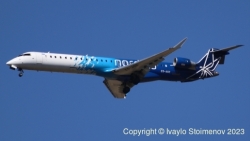
Bombardier CRJ
A Challenger-derived regional-jet family spanning the 50-seat CRJ100/200 and stretched CRJ700/900/1000.
Now supported by MHI RJ Aviation
Bombardier grew from a Canadian snowmobile company into a major aerospace group whose aircraft reshaped regional airlines and business aviation. Today it concentrates on Challenger and Global business jets, while the Dash 8, CRJ, CSeries and amphibious-aircraft programmes continue under successor manufacturers.
Bombardier Inc. was founded by Joseph-Armand Bombardier in Valcourt, Québec. The company was incorporated in 1942 to manufacture tracked snow vehicles based on his mechanical inventions. It later expanded from recreational products into rail transportation and, during the 1980s, aerospace.
Bombardier entered aircraft manufacturing in 1986 through the acquisition of the Canadian government-owned Canadair. Canadair brought the Challenger business jet, CL-215 amphibious water bomber and a long history of military, civil and experimental aircraft. The acquisition also provided Bombardier with a substantial engineering and manufacturing base in Montréal.
The aerospace group expanded rapidly. Bombardier acquired Short Brothers of Belfast in 1989, Learjet of Wichita in 1990 and de Havilland Canada from Boeing in 1992. These acquisitions brought together business jets, commuter transports, regional turboprops, aircraft structures and specialised programmes.
The Canadair Regional Jet, usually called the CRJ, first flew in 1991. It adapted the Challenger business-jet fuselage into a fast 50-seat regional airliner and helped create a major new market. Later CRJ700, CRJ900 and CRJ1000 variants increased capacity while retaining the family’s narrow fuselage and rear-mounted engines.
The Dash 8 turboprop had originated at de Havilland Canada before Bombardier acquired the company. Under Bombardier, the family was developed through the Q Series branding and the substantially larger Dash 8 Q400. Its combination of speed, short-field capability and regional efficiency made it a major competitor to ATR turboprops.
Bombardier also became one of the leading business-jet manufacturers. It expanded the Challenger line, developed the clean-sheet Challenger 300, introduced the intercontinental Global Express and continued the Learjet family. These programmes covered light, midsize, large-cabin and ultra-long-range business aviation.
The company’s most ambitious commercial-aircraft programme was the CSeries. The clean-sheet CS100 and CS300 used geared turbofan engines, advanced aerodynamics and extensive lightweight materials to target the lower end of the mainline single-aisle market. The CS100 first flew on 16 September 2013 and entered commercial service with SWISS in July 2016.
Heavy development costs and financial pressure led Bombardier to restructure. Airbus acquired majority control of the CSeries partnership in 2018 and renamed the aircraft A220. Bombardier transferred its remaining interest in 2020, completing its exit from the programme.
The Dash 8 programme was sold in 2019 to Longview Aviation Capital and returned to the De Havilland Aircraft of Canada identity. Mitsubishi Heavy Industries acquired the CRJ programme in 2020 and created MHI RJ Aviation Group to support the global fleet. Bombardier had earlier sold the CL-215 and CL-415 amphibious-aircraft programme to Viking Air, now within De Havilland Canada.
Bombardier also ended Learjet production in 2022 after more than 3,000 Learjets had been delivered. The modern company now focuses on Challenger and Global business aircraft, defence and special-mission adaptations, aircraft services and support. Its current flagship is the Global 8000.
Joseph-Armand Bombardier establishes the company around tracked snow-vehicle production.
Bombardier enters aerospace and gains the Challenger and CL-215 programmes.
The Belfast manufacturer adds commuter aircraft and major aerostructures expertise.
Bombardier enters the light and midsize business-jet market.
The Canadair Regional Jet launches a new era of 50-seat regional jet service.
The Dash 8 turboprop family joins Bombardier.
Bombardier enters the ultra-long-range, large-cabin business-jet market.
Active noise and vibration suppression supports the “Quiet” Q Series identity.
The high-speed 70-seat-class turboprop becomes the largest Dash 8 variant.
A clean-sheet super-midsize business jet expands the Challenger name.
The CS100 flies from Mirabel on 16 September.
SWISS introduces the CS100 on scheduled passenger operations.
Airbus assumes majority control and markets the CS100 and CS300 as A220-100 and A220-300.
Longview acquires the complete Dash 8 programme from Bombardier.
MHI RJ Aviation Group takes over programme support and services.
Production ends after a six-decade business-jet lineage.
The CRJ, CS-series, Dash 8 and Q-series were initially developed at Bombardier, but were later transfered to other companies. CRJ is part of Mitsubishi Heavy Industries. The CSeries is a historical bridge to the Airbus A220, while Dash 8 is covered under De Havilland Canada section.
A Challenger-derived regional-jet family spanning the 50-seat CRJ100/200 and stretched CRJ700/900/1000.
The CS100 and CS300 introduced geared turbofans and a modern five-abreast cabin before becoming the Airbus A220.
The de Havilland Canada Dash 8 developed under Bombardier into the Q100, Q200, Q300 and high-speed Q400.
The business-aircraft section is organised around three definitive family pages. Each page combines history, variants, specifications, production, active-fleet context and aircraft-detection links.
The complete Challenger story, from the Canadair CL-600 and its 601/604/605/650 descendants to the clean-sheet Challenger 300, 350 and 3500, plus the CRJ-derived Challenger 800 and 850.
The Global Express lineage and its later Global 5000, XRS, 5500, 6000, 6500, 7500 and 8000 developments, including the aircraft's changing wings, engines, cabins and mission capability.
Six decades of fast, compact business jets, from the Model 23 and classic 20/30 series through the 55/60, clean-sheet 45, shorter 40 and final Learjet 70/75 generation.
Purpose-built water-bombing amphibians inherited with Canadair and developed into the turbine-powered CL-415.
Boxy, rugged regional transports produced by Short Brothers before and during the company’s Bombardier ownership.
A broader heritage including the CL-44 transport, CL-84 tilt-wing, CL-600 Challenger and military programmes.
Bombardier’s aviation history cannot be understood from the current company website alone. Its former programmes now belong to several manufacturers and support organisations.
howmany.travel connects manufacturer history with individual aircraft identified through Mode S, ADS-B and related radio transmissions. Bombardier-origin aircraft require careful naming because an aircraft may retain a Bombardier type identity while its programme is now supported by Airbus, De Havilland Canada or MHI RJ Aviation.
The links below are prepared in the same structure as the Airbus and Boeing archives. They will work wherever the corresponding monthly log pages are present.
The portal uses one definitive page for each principal Bombardier aircraft family. The Dash 8 remains listed here because of its important Bombardier history, while the detailed family page is maintained under De Havilland Canada.
| Family | General category | Delivered | Active fleet |
|---|---|---|---|
| Challenger family | Business jets | ~1,500 | ~1,450 |
| Global family | Long-range business jets | ~1,100 | ~1,050 |
| Learjet family | Light and midsize business jets | ~3,050 | ~2,000 |
| CRJ family | Regional jets | 1,945 | ~1,300 |
| Dash 8 family | Regional turboprops | ~1,700 | ~1,100 |
| CSeries / A220 | Narrow-body airliner | 526 | 522 |
The Bombardier name remains common in aircraft registrations, databases and enthusiast usage even where the programme is now owned or supported by another company. Both identities should therefore be retained in search metadata and model-page text.